
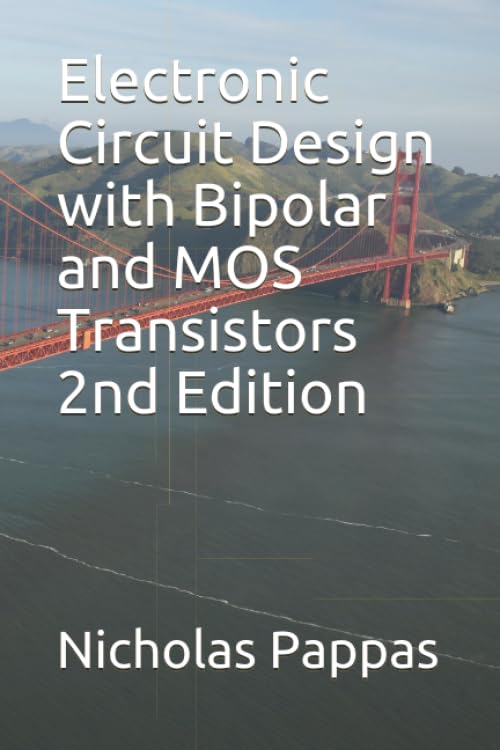
Electronic Circuit Design with Bipolar and MOS Transistors 2nd Edition (Electrical and Electronic Engineering Design Series)
Produktdetails
| Artikelnummer | 233660577 | Erscheinungsdatum | 2026/06/27 | Listenpreis | €10.44 | Modellnummer | 233660577 | ||
|---|---|---|---|---|---|---|---|---|---|
| Kategorie | |||||||||
Electrical and Electronic Engineering Design Series Vol 2Electronic Circuit Design - with Bilpolar Junction Transistors and MOS TransistorsThis university level Electrical Engineering text is for anyone who wants to know how to design electronic circuits. The present text is unusually accessible to readers who want to acquire the skills of electronic circuit design. We present a thorough foundation so that you can proceed to learn how to design any circuit.Furthermore you will learn how to design and include in your electronic circuits multistage amplifiers, feedback amplifiers. operational amplifiers, tuned amplifiers, and oscillators, basic digital circuits, and vacuum tube circuits.Electronic circuits are designed in two basic forms. One form uses discrete parts placed on a printed circuit board. The second form is an integrated circuit placed on a silicon chip.There are two major classes of transistors in use today. BJT bipolar junction transistors and MOS field effect transistors. We leave the why of device physics to semiconductor texts.We explain the BJT transistor AC and DC properties. We show how to design current mirror and differential amplifier BJT analog building blocks that are widely used in complex BJT analog and digital integrated circuits. We explain resonant circuits so that we can show how to design elementary filters, tuned amplifiers, and oscillators.The MOS transistor AC and DC properties are explained. We show how to design, in integrated circuit format, current mirror and differential amplifier MOS analog and digital building blocks that are widely used in complex MOS analog circuits. We show how to design an operational amplifier, an LC tuned circuit amplifier, an LC oscillator, and CMOS digital citcuits.We explain feedback as Bode conceived it. We place the BJT and MOS amplifiers we designed into feedback structures, and apply Nyquist's Stability Theory to the amplifiers. And, feedback circuit design is illustrated by designs of one and two stage BJT feedback amplifiers, MOS voltage feedback amplifiers (VFA), and a BJT current feedback amplifier (CFA).Two basic types of op amp are the voltage feedback amplifier (VFA), and the current feedback amplifier (CFA).The useful ideal and realistic properties of VFA and CFA are made clear so that one can design circuits using them. Ideal models of both types are analyzed. Their very useful ideal characteristics simplify analysis of practical circuits that include VFA and CFA op amps. A practical op amp differs from the ideal in several ways such as finite gain. Practical VFA and CFA models are developed and analyzed so that you know when to use the practical models instead of the ideal op amp models which are surprisingly useful.The text includes extensive use of the Spice simulation program to produce frequency domain response plots of sinewave input signals, input DC voltage to output DC voltage transfer function plots, and output transient time domain response plots of modified input signal waveforms. The plots give life to the circuit equations so that you can “see” circuit performance. The text shows how you can leave the number crunching to Spice so that you can focus on your designs.The presentations are eminently clear, because they are based on the policies assume nothing and nothing is obvious. The present text's contents are topics one actually uses when engaged in electronic circuit analysis and design. Fourteen experiments are included that give life to the text’s contents, and provide the reader with real world experience making measurements, using instruments, and learning about all kinds of parts. We consider the experiments to be significant learning activities. Read more
| ISBN10 | 1689205997 |
|---|---|
| ISBN13 | 978-1689205993 |
| Language | English |
| Publisher | Independently published |
| Dimensions | 6 x 0.75 x 9 inches |
| Item Weight | 1.06 pounds |
| Print length | 330 pages |
| Publication date | September 2, 2019 |
Korrektur der Produktinformationen
Wenn Sie Unvollständigkeiten oder Fehler in den Produktinformationen auf dieser Seite bemerken, nutzen Sie bitte das Korrekturformular unten.
Korrekturanfrage